The TikTok “niche dream”: when romantic fantasies turn into drama
 ">La Seductrice
Follow on X
Send an email
">La Seductrice
Follow on X
Send an email
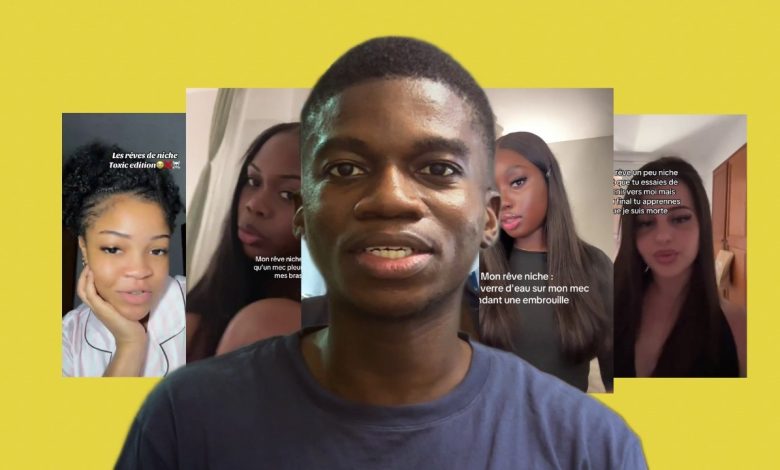
The niche dream trend on TikTok involves sharing a romantic fantasy presented as highly personal, or even unusual. In the video discussed by Tobeh, the examples quickly move away from simple romantic scenes: arguments, jealousy, tears, breakups, infidelity and emotional distress take on an important role.
The content creator questions this accumulation of painful scenarios. His point is not to establish a general truth about women or relationships, but to react to the videos he has seen and the stories highlighted in this trend. In particular, he notes that several posts present romantic suffering as a central element of the fantasy.
What is the “niche dream” on TikTok?
According to the examples mentioned in the video, the principle is to express a relationship desire that may not necessarily be shared by everyone. The word niche therefore suggests something specific, intimate or uncommon.
However, Tobeh believes that some content does not really fit this idea. Wishes such as having an attentive, cultured, romantic partner who gives flowers or shields the other person from tiring chores seem to him more like a widely shared romantic ideal than a singular fantasy.
By contrast, other cited videos move toward darker scenarios: wanting to be comforted after a breakdown, seeing one’s partner cry, experiencing a dramatic breakup or discovering cheating. It is this second category that mainly draws the commentator’s attention.
Fantasies built around conflict
Several situations described in the video are based on the idea of intense conflict followed by a demonstration of love. One participant, for example, imagines an argument with her partner, him driving away after drinking, followed by the worry and phone calls that ensue. Another mentions the fantasy of being with a man who argues easily, but whom she would be the only one able to calm down.
Tobeh reacts with concern to this kind of staging. In particular, he stresses that violent or uncontrollable behavior should not be romanticized. In his commentary, he distinguishes the fantasy of a dramatic scene from the reality of a relationship in which one person may frighten, humiliate or hit their partner.
Through the content creator’s reactions, the video thus recalls that argument scenarios are not harmless when they include insults, slaps, blows or fear of escalation. The imagined regret after violence does not lessen the seriousness of the act described.
Tears as proof of attachment
Another recurring theme is tears. Some of the participants cited dream of breaking down in their partner’s arms and seeing him affected by their suffering. Others say they want a man to cry in their arms, confide in them and express what he keeps deep inside.
However, Tobeh warns against an overly romantic reading of distress. He insists that crying does not carry the same meaning depending on the reason for those tears. Sadness linked to bereavement, a personal ordeal or deep suffering should not be reduced to an emotional sequence intended to prove love within a couple.
The commentary primarily targets the staging of pain: in some accounts, suffering seems to be sought because it would produce a strong reaction from the other person. The content creator questions this desire to see one’s partner devastated, as though the intensity of their suffering became confirmation of the relationship’s value.
Infidelity: the appeal of a dramatic revelation
What fascinates Tobeh most is the repeated presence of infidelity in the “niche dreams” mentioned. Several scenes are described as moments of revelation: catching a loved one with someone else, discovering messages on a phone, receiving screenshots or investigating until realizing that one’s partner is leading a double life.
In these examples, cheating is not described as part of a plan for a balanced relationship. It becomes the driving force of a story: the discovery, the shock, the anger, the escape, the pursuit and the partner’s reaction. One participant even mentions the idea of realizing that she is not the official partner, but the person with whom a man is cheating on his long-term partner.
The content creator also notes scenarios in which the absence of a spouse or partner would serve as the setting for an affair with another person. He interprets them as fantasies of tension and transgression rather than simple romantic desires.
His surprise concerns less the existence of thoughts or curiosities than their promotion as an experience to live through. In the clips he comments on, some people seem to want to feel the pain of betrayal in order to know what it feels like or to experience a particularly powerful emotion.
Why do these stories attract attention?
The video does not provide a general psychological explanation for this trend. However, Tobeh mentions a connection with highly dramatic fictional worlds, particularly stories in which love is associated with crises, separations, reunions and spectacular gestures.
In this context, the “niche dream” appears to be a way of telling a scene rather than describing a lasting relationship. What matters in the examples cited is not only the presence of a partner, but an emotional sequence: being pursued, being regretted, prompting tears, provoking jealousy or discovering a betrayal.
This logic also explains why some fantasies seem to contradict the well-being sought in a relationship. Drama produces a story and a visible reaction. But, as the content creator recalls when discussing violence or distress, a real situation cannot be reduced to the aesthetic of a TikTok sequence.
A more peaceful conclusion with “Christian TikTok”
To conclude, Tobeh shows an example from what he calls “Christian TikTok.” In it, the person expresses the wish to become a better version of the believing woman she was before an event that turned her life upside down.
The contrast with the previous accounts is clear. Here, the desire expressed is not based on an argument, cheating or suffering imposed on another person, but on personal growth. Tobeh reacts positively to this formulation, which he presents as more serene after the accumulation of dramatic scenarios discussed throughout the video.
FAQ on the “niche dream” trend
What does “niche dream” mean on TikTok?
In the videos cited by Tobeh, the expression refers to a romantic fantasy presented as specific or uncommon. The content can range from a romantic ideal to much more dramatic scenarios.
What themes recur in the examples discussed?
The video mentions arguments, tears, the need to be comforted, jealousy, separation and infidelity, among other themes. Tobeh observes that these elements frequently recur in the posts he watched.
Does the video claim that all women enjoy suffering?
No. The title and the content creator’s reactions are based on a theory he mentions and on a selection of TikTok videos. These examples do not make it possible to draw a general conclusion about all women or all relationships.
Video source: A video by Tobeh: It seems like women enjoy suffering (Niche Dream Edition)
">La Seductrice
Follow on X
Send an email